
India has accumulated experience organically and in public, through blood, sweat and toil -- one commissioning and one agreement at a time -- and is called a regional power. China has accumulated hulls, by misdirecting its industrial capacity, and is mistakenly called a superpower. The Indo-Japan defence agreement pushes this theory to its limits without ever naming the dragon in the room, points out Dr Abhishek Puri.

India and Japan have signed a Memorandum of Arrangement on maritime security cooperation, committing to deepen defence ties and oppose unilateral actions that impede freedom of navigation in the Indo-Pacific, a move seen as directed at China's increasing military presence.

Japan is deepening its defence relationship with India while simultaneously expanding its economic, infrastructure and security engagement with countries around India -- particularly Bangladesh. The result is an emerging Japanese conception of South Asia in which India remains the strategic anchor, but the geography surrounding India is becoming increasingly important, points out Varun Arya.

The political confidence required to place high-end Japanese aircraft and personnel on Indian soil is itself a data point.
It indicates a level of trust that would have been difficult to imagine when India-Japan defence ties were largely symbolic, explains Varun Arya.

The goal of the CDS' visit was to emphasise the rising significance of defence collaboration between India and Japan while reiterating strategic cooperation
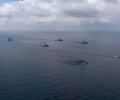
The mega exercise took place at a time India and China are locked in a nearly six-month-long bitter border standoff in eastern Ladakh.

Though Mukherjee did not specify a date for the naval exercise, sources told PTI that it will be held in April.

Indian and Japanese ships engaged in advanced level exercises in all three domains of maritime warfare -- surface, sub surface and air.
History may remember Takaichi Sanae not as the leader who simply accelerated Japanese rearmament, but as one who governed during Japan's transition from an industrial-age security model to a post-industrial strategic member of the global order, points out Varun Arya.

Notwithstanding the economic complementarities and the host of agreements for deepening economic relation on a host of areas, both sides share common viewpoints on the foreign policy domain and seek common grounds to serve as a counterweight to China, notes Dr Rajaram Panda.

India and Japan are set to intensify defence cooperation with the two sides likely to launch a security consultative framework involving their foreign and defence ministers.

INS Vagir set a new record for the longest-ever deployment of any Scorpene-class submarine, covering a distance of 7,000 kilometres to reach Australia for joint military exercises.

With over 75 per cent indigenous content, the frigate is among the most self-reliant frontline warships built in India.

The India-Japan joint naval exercises are a strategic signal for China, observes Dr Rajaram Panda.
"Two destroyers, one maritime patrol aircraft and a helicopter of the Japanese Maritime Self Defence Force (JMSDF) will participate in the exercise whereas INS Rana, INS Shivalik, INS Karmukh and fleet tanker INS Shakti will represent India," the Indian Navy said on Friday.

In a region increasingly shaped by competition and coercion, such collaboration strengthens security without confrontation, builds capacity without dependency and promotes order without domination, points out Dr Kumar.

In the Indo-Pacific's new era -- where perception shapes reality faster than treaties -- the real entrapment is not of China or the United States. It is the test Japan has set for itself -- and whether partners like India, acting as balancers rather than accelerants, can help ensure that the story ends in stability, points out Varun Arya.
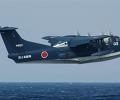
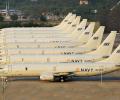
New Delhi's growing defence partnership with Tokyo could take wing with the US-2 (Utility Seaplane Mark 2), a one-of-a-kind amphibious aircraft that has Indian naval planners goggle-eyed.

For the foreseeable future, the most likely outcome remains continuation of the status quo. Taiwan will remain self-governing without formally declaring independence, while China continues to apply sustained pressure short of war, predict Krishnan Srinivasan and Manoj Mohanka.
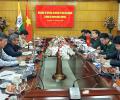
The 15th India-Vietnam Defence Dialogue signalled a move from routine talks to deeper cooperation, with new deals on submarine rescue and defence industry to support stability in the Indo-Pacific, notes Dr Rajaram Panda.
Rediff.com's Vipin Vijayan, who is travelling with Prime Minister Manmohan Singh to Japan, reports from Tokyo.

Four frontline warships of the Indian Navy participated in the 'PASSEX' exercise when the US carrier strike group was transiting through the Indian Ocean Region on its way from the South China Sea, the officials said.

The 19th edition of the Malabar naval exercise saw the Indian, US and Japanese maritime forces participated jointly in the routine.

The compulsion behind India and Japan to deepen security cooperation is in response to China's growing political and economic clout and its assertive behaviour in disputed areas. This has been the key driver for bringing both India and Japan closer in the domain of security cooperation, explains Dr Rajaram Panda.

The trigger that led Japan and the Philippines to ink the deal was because of the deteriorating security situation in the South China Sea. China's coast guard increased the frequency and intensity of incursions into Philippine waters, provoking the Philippines to take countermeasures to deter China, explains Dr Rajaram Panda.

As Japan beefs up its defences against China, both New Delhi and Tokyo seem to have decided to re-energise their relationship to ensure a strategic balance in Asia. It is a clear signal that they may be ready to work together in containing if not confronting China, says Nitin Gokhale.
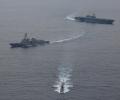
The second phase of the mega exercise is scheduled to be held from November 17 to 20 in the Arabian sea.

Police officers on duty at the venue where former Japanese prime minister Shinzo Abe was shot didn't recognise a suspicious man in the crowd until hearing the first gunshot, Japan's public broadcaster NHK reported on Saturday.

The exercise is taking place at a time India and China are locked in a nearly six-month-long bitter border standoff in eastern Ladakh that has significantly strained their ties.

The purge in Washington does not pause the war. Strikes continue, Hormuz remains closed, and Brent crude is still dancing around $109 a barrel. For India, the command chaos in the Pentagon is another layer of uncertainty piled on five weeks of conflict that was already straining every buffer Delhi has.

This weekend, Donald Trump has begun to say the quiet part out loud -- that he wants to take control of Iran's oil, a formulation more in line with his robber-baron style of international relations.

95 aircraft, 16 ships and 2 submarines from 3 countries are taking part in Malabar exercise.
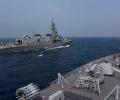
The navies of India, the US, Japan and Australia on Tuesday held a series of complex manoeuvres in the Bay of Bengal, kick-starting the four-day-long first phase of the Malabar naval exercise, seen as a prelude to future military cooperation among the member nations of the Quad or Quadrilateral Coalition.
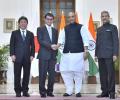
The India-Japan 2+2 dialogue added strategic heft to the special relationship in the wake of growing Chinese assertiveness on regional affairs, points out Dr Rajaram Panda.

Japan could soon be the second country after the US with which India has a logistics support agreement. Besides the LSA, India and Japan may also sign a maritime domain awareness agreement which would enable the two navies to share information. For example, if a Japanese P-1 maritime patrol aircraft detects a Chinese submarine in the Indian Ocean, it would pass on the information to the Indian Navy, reveals Ajai Shukla.

Announcing the hotline, the Chinese defence ministry said as agreed upon by the defence departments of China and Japan, the two sides have recently completed the construction of a direct telephone line for the sea and air liaison mechanism and will maintain communication on the arrangement for the launch.
The sources said the military brass is considering deploying Indian Navy's MiG-29K fighter jets in a couple of air bases in the northern sector as part of efforts to bring in tri-services synergy in dealing with national security challenges.
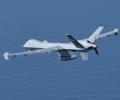
In a late night statement, the White House said completion of these sales would increase bilateral defence trade to nearly USD 19 billion, supporting thousands of US jobs.

The agreement provides for creation of an enabling framework for closer cooperation and interoperability, besides allowing militaries of the two countries to use each other's bases and facilities for repair and replenishment of supplies, the official said.
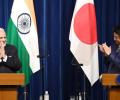
During the 13th annual summit, the two prime ministers reviewed developments in bilateral relations and explored new areas of cooperation, focusing on shared vision for peace and prosperity in the Indo-Pacific, where China is flexing its muscles.
